
Rotator Cuff Injury Treatment
Most rotator cuff injuries — including many tears — recover well without surgery. At PMC (Pain Management Clinic) by Dr. Waqar Ali, we treat rotator cuff tendinopathy, impingement, and partial tears with a personalized, non-surgical physiotherapy plan — combining advanced physiotherapy machines such as shockwave therapy, hands-on manual therapy, and progressive strengthening to relieve your shoulder pain, rebuild strength, and get your arm moving freely again. If shoulder pain is disturbing your sleep or stopping you reaching overhead, start with a detailed assessment at our Lahore or Rawalpindi centres.

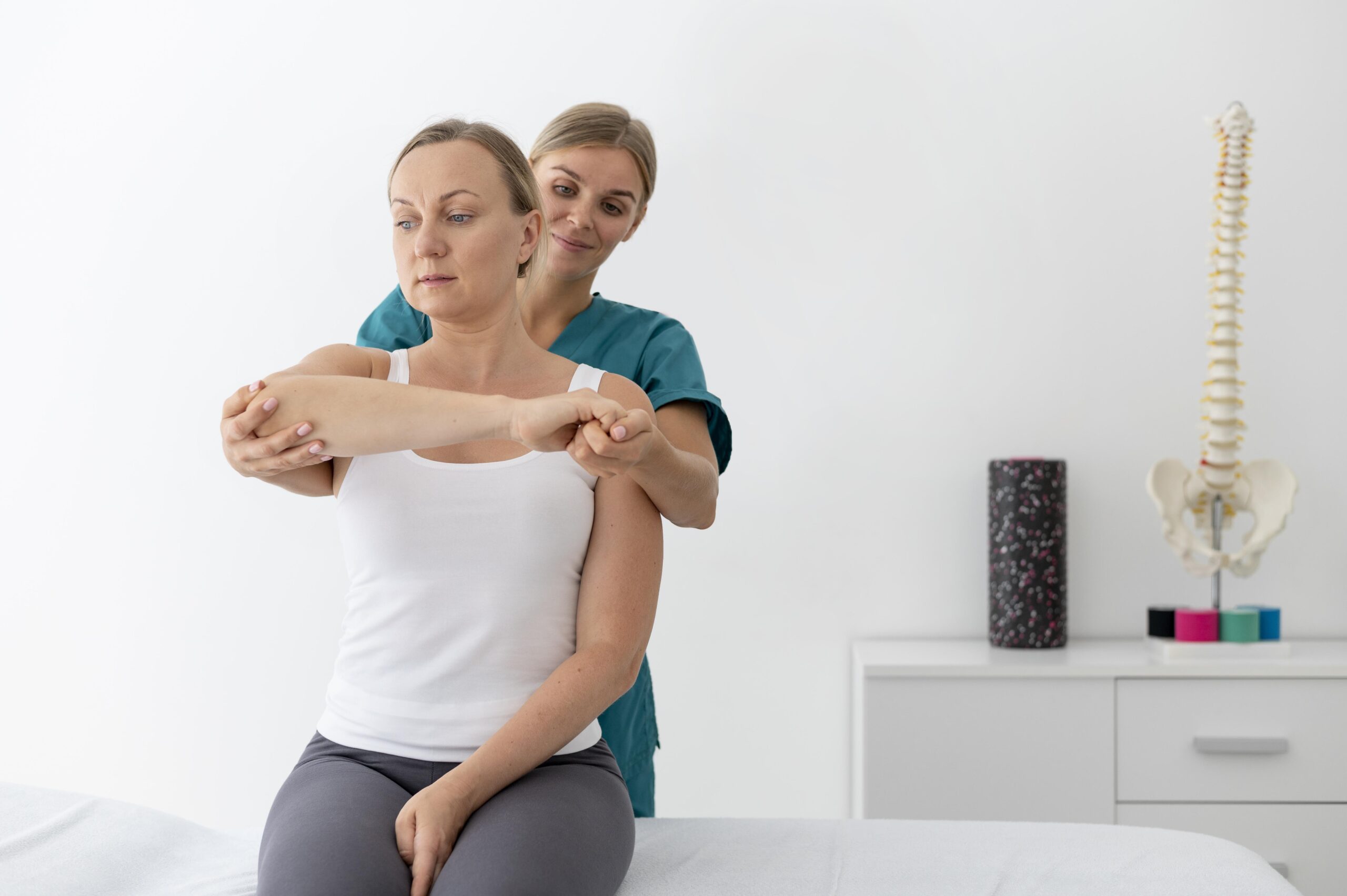
What is the rotator cuff, and how does it get injured?
The rotator cuff is a group of four muscles and their tendons that wrap around your shoulder joint — they lift and rotate the arm and, crucially, hold the ball of the shoulder centred in its shallow socket. Because these tendons work in a tight space and are used in almost every arm movement, they are the most commonly injured structures in the shoulder. Rotator cuff injuries fall on a spectrum: tendinopathy (an irritated, overloaded tendon), impingement (the tendon pinching against bone during overhead movement), and tears — which can be partial or full-thickness. Importantly, degenerative tears become increasingly common after 40 and are often found on scans of people with no pain at all.
What are the symptoms of a rotator cuff injury?
- Pain on the outside of the shoulder, often spreading down the upper arm
- Pain when reaching overhead, behind your back, or out to the side — often a “painful arc” midway through lifting the arm
- Night pain, especially when lying on the affected shoulder — a hallmark of rotator cuff problems
- Weakness lifting or rotating the arm — difficulty with combing hair, reaching a shelf, or lifting a kettle
- Clicking or catching sensations with movement
When to seek care promptly: sudden loss of strength after a fall or injury, inability to lift the arm at all, or shoulder pain with visible deformity should be assessed early — acute full-thickness tears in younger patients have better outcomes when identified quickly.

How we treat rotator cuff injuries at PMC
Our approach is non-surgical, evidence-based, and personalized to your diagnosis. Research shows that structured exercise rehabilitation achieves outcomes comparable to surgery for most degenerative rotator cuff problems — so that is the core of our plan, supported by the right modalities:
- 1. Detailed assessment. Dr. Waqar Ali and our physiotherapy team test your shoulder movement, strength, and specific rotator cuff function to identify which tendon is affected and whether a tear is likely, before any treatment begins.
- 2. Shockwave and advanced physiotherapy machines. Where appropriate, we use shockwave therapy — particularly effective for stubborn and calcific tendinopathy — alongside electrotherapy, therapeutic ultrasound, and laser therapy to settle pain and stimulate tendon healing. These modalities support the plan, never replace it.
- 3. Manual (hands-on) therapy. Joint mobilization and soft-tissue techniques restore movement to the shoulder and upper back and ease the protective muscle tension around a painful cuff.
- 4. Progressive strengthening and loading. A staged program that rebuilds the rotator cuff and shoulder-blade muscles — starting gentle, progressing steadily. Loading the tendon correctly is the treatment most strongly supported by evidence for lasting recovery.
- 5. Movement retraining and education. We correct overhead technique, posture, and daily habits — how you lift, reach, and sleep — so the tendon stops being re-irritated and improvement lasts beyond the clinic.
What Our Clients Say
EXCELLENT Based on 155 reviews
 Posted on Google
 NAWAZ GUJJARMeri neck k moro ka msla tha bht zada ma ne baht elaj krwaya but pain thk ni ho ri thi phr ma pmc ai yha ma kch sessions liye now I'm 💯 %recoverd totally recommendedPosted on Google
 Sad MisI had a knee and back problem. I have tried many steroid injections but it didn't work. Then I visited PMC and got my treatment. I am very satisfied with their services as within few weeks I got better. All doctors are very cooperative. Dr maimoona treated me soo well. Highly satisfied.Posted on Google
 Anam KI highly recommend Dr. Aresha! I was suffering from severe cervical issues and intense pain but her professional approach and effective therapy sessions made huge difference. She listens carefully, explains the treatment plan, and provide comfort throughout the process. Thanks to her care, my pain has reduced significantly.❤️Posted on Google
 irfan faniTo be honest they are dealing with best treatment I am curing day by day and Allhamdullillah more power to Dr Waqar Ali and Staff plzz don't waste your time by using such heavy medications they are best. Shukria.Posted on Google
 ShaheenI have a pain in my back and neck from few months bht med li ma ne but relief ni a ra tha phr ma pmc ai yha ma ne kch sessions liye ab ma kafi better hn Alhmdulillah and my doctor is so cooperative must visit to Dr Ayesha she is so professional totally recommendedPosted on Google
 Sheikh Salman InayatGood behavior good guidelines good Dr mashAllahPosted on Google
 Hamza WattooMujhe knee pain tha to mein ny Hahn se treatment karvata to Mein full recovery hoe hao PMC clinic se
Self-help tips for rotator cuff pain relief at home
01
Keep the shoulder moving, gently. Complete rest stiffens the shoulder — use the arm within comfort for daily tasks, avoiding only the sharply painful movements.
02
Modify overhead activity. Temporarily reduce reaching and lifting above shoulder height; bring tasks down to chest level while the tendon settles.
03
Adjust your sleeping position. Avoid lying directly on the painful shoulder; a pillow supporting the arm in front of you often eases night pain.
04
Use cold or heat. A cold pack can calm a fresh flare-up; heat helps relax tight muscles around a longstanding problem.
05
Don’t stretch into sharp pain. Forcing the arm up through pain irritates the tendon further — progress should feel like gentle work, not punishment.
Ready to sleep through the night and reach overhead again?
Don’t let a rotator cuff injury slowly shrink what your shoulder can do. Book a detailed assessment with PMC by Dr. Waqar Ali and get a personalized, non-surgical treatment plan built for your recovery.
Lahore: +92-320-7177607 Rawalpindi: +92-312-0796089