
Scoliosis Treatment in Lahore & Rawalpindi
Most scoliosis curves are mild, most never need surgery — and the right care during the growing years is what keeps it that way. At PMC (Pain Management Clinic) by Dr. Waqar Ali, we assess and treat scoliosis in teenagers and adults with scoliosis-specific exercise programs, posture and strength training, and honest monitoring — coordinating with spine specialists and bracing services when a curve needs more. Whether you’ve just noticed uneven shoulders in your child or you’re an adult with a curved, aching spine, start with a detailed assessment at our Lahore or Rawalpindi centers.
What is scoliosis and how do you spot it?
Scoliosis is a sideways curve of the spine, usually with some rotation, measured on X-ray as a Cobb angle of 10 degrees or more. It most often appears in adolescents during the growth spurt — more commonly in girls — and usually causes no pain at that age, which is why it’s often first noticed in the mirror or by a parent or tailor rather than felt.
The most common type, appearing between roughly 10 and 16 years with no single known cause. What matters most is the curve size and how much growth remains — because curves progress fastest during growth spurts. This is exactly when monitoring and treatment have the most power.
Either an adolescent curve carried into adulthood, or a new curve developing later in life as spinal discs and joints wear unevenly. Unlike teenage scoliosis, adult scoliosis often does cause aching, stiffness, and sometimes nerve symptoms — and responds well to strengthening-based treatment aimed at pain and function.
Can scoliosis be treated without surgery?
In most cases, yes — treatment depends on the curve size and, in adolescents, remaining growth. Mild curves (roughly 10–25 degrees) are usually managed with monitoring and scoliosis-specific exercise. Moderate curves in a still-growing adolescent (roughly 25–45 degrees) benefit from bracing — proven in clinical trials to reduce the risk of progressing to surgery — combined with exercise. Surgery is generally considered only for severe curves (around 45–50 degrees and beyond) or rapid progression. Research on scoliosis-specific exercise approaches such as the Schroth method — including a randomised trial conducted here in Lahore — shows improvements in posture, trunk strength, breathing, and quality of life, and evidence of reduced curve progression in growing adolescents. What no honest clinic will promise: that exercise or any device “straightens” a structural curve. What we can promise is the evidence-based path: measure, strengthen, monitor, and escalate only when genuinely needed.
How we treat scoliosis at PMC
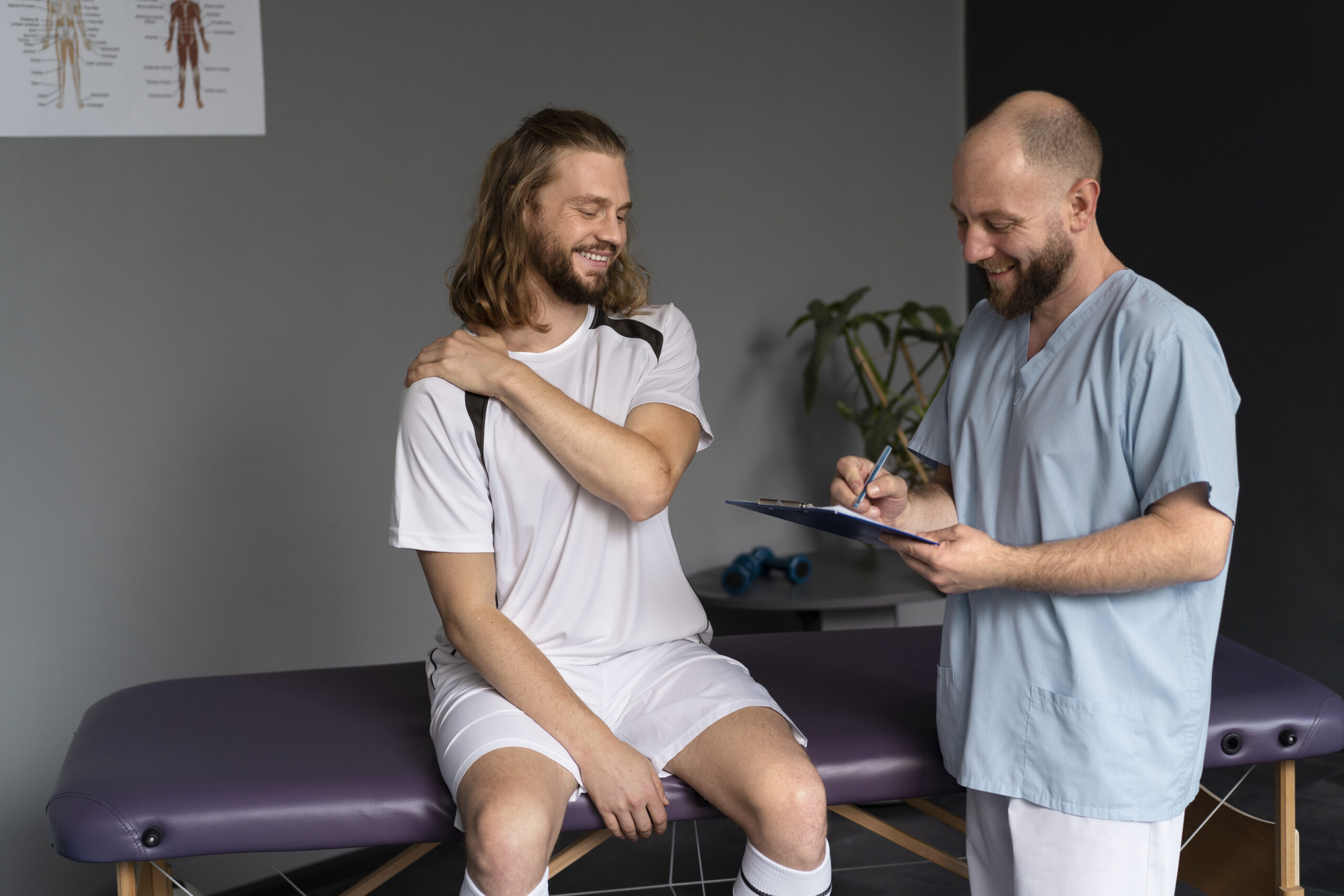
Our approach is stage-based, evidence-led, and coordinated — built around the curve, the age, and the goal.
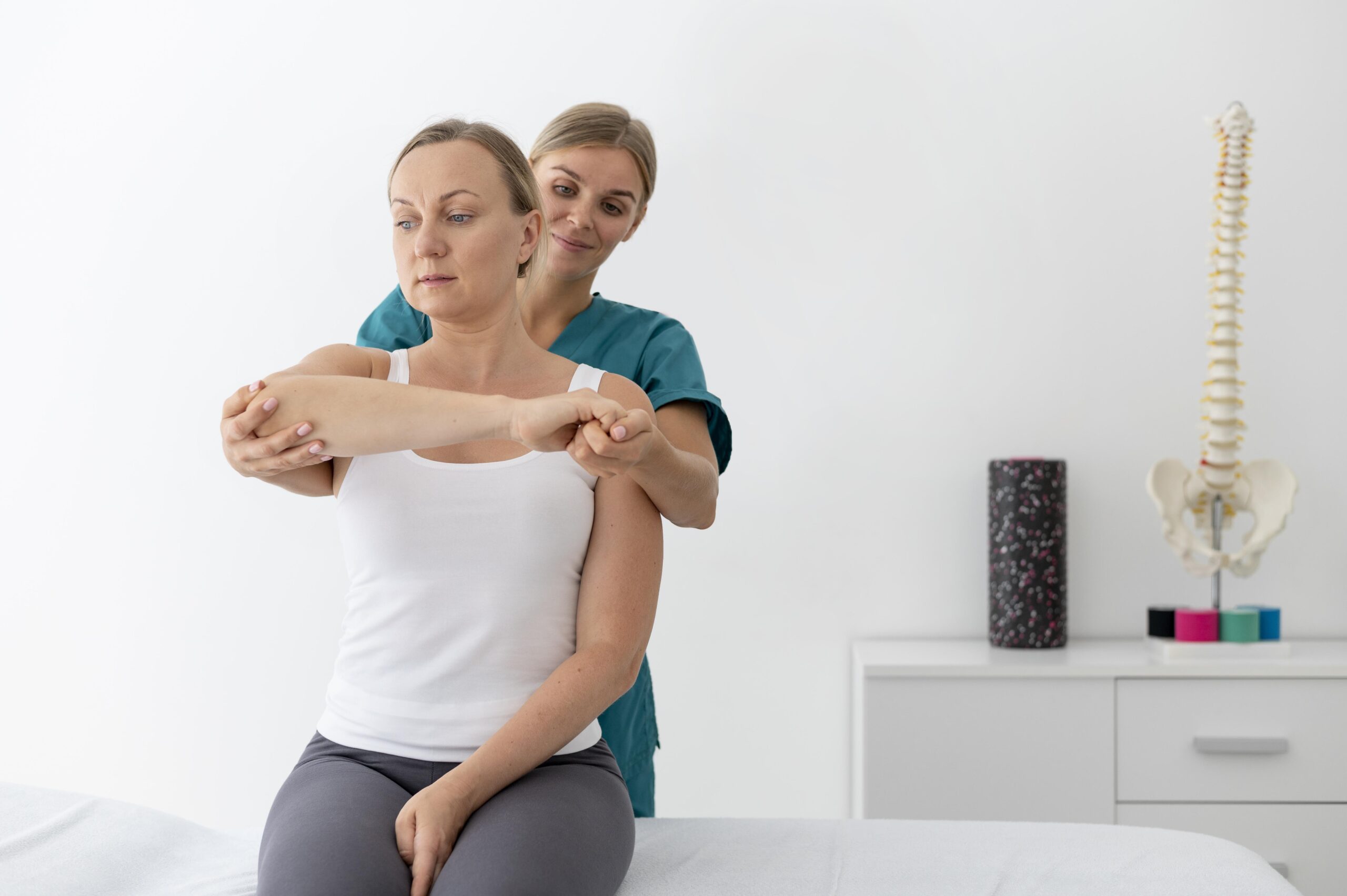
- Detailed assessment. Dr. Waqar Ali and our team screen the spine (including the forward-bend test), assess posture, trunk strength, flexibility, and leg length, review any X-rays and the Cobb angle, and — for adolescents — factor in growth stage, which drives every decision.
- Scoliosis-specific exercise. A personalized program based on internationally recognised scoliosis-exercise principles (including Schroth-based methods [CONFIRM exact certification/wording]) — training postural awareness, asymmetric strengthening, spinal elongation, and breathing mechanics tailored to your curve pattern.
- Strength, mobility, and pain care. Progressive trunk and hip strengthening for support, manual therapy and modalities where needed for adult curves with pain, and general conditioning so the spine is supported for life, not just for the program.
- Monitoring and coordination. Growing adolescents are reviewed on a schedule with repeat measurements, and we coordinate with orthotists for bracing and with spine specialists [CONFIRM referral partners] the moment a curve crosses the thresholds — no wait-and-hope.
- Education for the family. We teach the patient — and for teenagers, the parents — what the curve means, what actually influences it, which activities are safe (almost all, including sport), and what to watch for between reviews.
What Our Clients Say
EXCELLENT Based on 155 reviews
 Posted on Google
 NAWAZ GUJJARMeri neck k moro ka msla tha bht zada ma ne baht elaj krwaya but pain thk ni ho ri thi phr ma pmc ai yha ma kch sessions liye now I'm 💯 %recoverd totally recommendedPosted on Google
 Sad MisI had a knee and back problem. I have tried many steroid injections but it didn't work. Then I visited PMC and got my treatment. I am very satisfied with their services as within few weeks I got better. All doctors are very cooperative. Dr maimoona treated me soo well. Highly satisfied.Posted on Google
 Anam KI highly recommend Dr. Aresha! I was suffering from severe cervical issues and intense pain but her professional approach and effective therapy sessions made huge difference. She listens carefully, explains the treatment plan, and provide comfort throughout the process. Thanks to her care, my pain has reduced significantly.❤️Posted on Google
 irfan faniTo be honest they are dealing with best treatment I am curing day by day and Allhamdullillah more power to Dr Waqar Ali and Staff plzz don't waste your time by using such heavy medications they are best. Shukria.Posted on Google
 ShaheenI have a pain in my back and neck from few months bht med li ma ne but relief ni a ra tha phr ma pmc ai yha ma ne kch sessions liye ab ma kafi better hn Alhmdulillah and my doctor is so cooperative must visit to Dr Ayesha she is so professional totally recommendedPosted on Google
 Sheikh Salman InayatGood behavior good guidelines good Dr mashAllahPosted on Google
 Hamza WattooMujhe knee pain tha to mein ny Hahn se treatment karvata to Mein full recovery hoe hao PMC clinic se
Self-help tips for living well with scoliosis
01
Stay active — sport is safe. Scoliosis is not a reason to sit out of games, gym, or swimming; activity builds the muscle support the spine needs. Very few curves need any activity restriction, and we’ll tell you if yours is one.
02
Do the program, not just the sessions. Scoliosis-specific exercises work through consistent daily practice at home — short, regular sessions beat occasional long ones.
03
Build your trunk strength. Planks, side-planks, and core work support any curve — teenagers and adults alike.
04
Don’t fear the school bag. Heavy bags don’t cause scoliosis — but a well-fitted backpack worn on both shoulders is still kinder to a growing, aching back.
05
Keep the review dates. For a growing adolescent, the schedule of check-ups is the treatment — progression caught early keeps every option open.
Worried about a curve? Get it measured, not guessed.
Whether it’s your teenager’s posture or your own aching back, the first step is the same: a proper assessment that tells you the curve, the stage, and the honest options. Book a detailed assessment with PMC by Dr. Waqar Ali.
Lahore: +92-320-7177607 Rawalpindi: +92-312-0796089